Restart the idle plants. It is the nearest cut in the gasoline price.
The world is short of refineries, and a large share of the ones it had are no longer running. Ukrainian strikes have knocked out a wide slice of Russian capacity. Fighting around the Gulf has damaged Middle East plants and choked product flows. Older sites in Africa, the Caribbean and the Arab world were already dark from war, sanctions and flood damage. Operating refineries in the United States and Europe are near the ceiling of safe runs.
The result is a refined-fuel gap on the order of 3.8 million barrels a day, and that gap is what drivers pay at the pump. Crude is not the binding constraint. The missing step is the plant that turns it into gasoline.
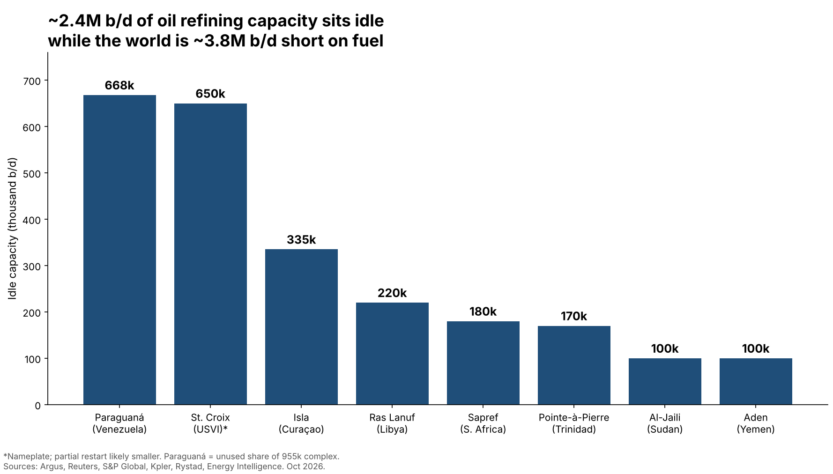
The nearest response is spare capacity in the very few places that still have it. I went looking for refining capacity sitting idle because it is too risky or expensive to restart, and found about 2.4 million barrels a day across eight plants: Venezuela’s Paraguaná complex, St. Croix, Curaçao’s Isla, Libya’s Ras Lanuf, Durban’s Sapref, Trinidad’s Pointe-à-Pierre, Sudan’s Al-Jaili and Yemen’s Aden. Most are not forgotten. A government or a bidder is circling several of them. Half are in this hemisphere. A new refinery is a seven-to-ten-year build. These are already poured.
Nameplate is not a switch
That 2.4 million barrel figure is currently idle plant, not barrels that can be turned on this winter. Paraguaná is rated near 955,000 barrels a day and has run at a fraction of that for years; a full restoration has been costed in the tens of billions, and a fire at Cardón this month took more of the operating portion offline. Isla, about 300,000 barrels a day, closed at the end of 2019 because the crude diet and the operator failed together. Trinidad’s Pointe-à-Pierre, dark since 2018, could see limited runs in about 18 months if capital is locked.
St. Croix, an unincorporated territory of the United States, is at zero. Its last restart, after more than $3 billion, lasted months; the current plan is a phased return above 200,000 barrels a day in 2027.
Ras Lanuf, Sapref, Al-Jaili and Aden need a ceasefire, a state balance sheet, or a rebuild. The honest first wave is the low hundreds of thousands of barrels a day from the Caribbean four. That does not close the gap. It is the increment that can show up before the next price spike.
What Washington can shorten
St. Croix is on U.S. soil, and the territorial governor has already asked Washington to treat it as a national asset. EPA dropped the old Reactivation Policy in 2025. Sequencing the remaining air, safety and operating approvals, putting a federal offtake under the products, and using a Defense Production Act priority on equipment and skilled labor is what turns a 2027 hope into a financed project. A licensed crude supply, with a named buyer, is the contract these plants have lacked.
Isla and Pointe-à-Pierre sit inside a shipping system Washington already runs. A crude waiver tied to a credible operator, export-credit cover, and an East Coast offtake remove the reason earlier restarts died. Paraguaná needs a narrower deal: capital and parts in, diesel and gasoline out, under an audit.
The Administration should rank St. Croix first, then Isla and Pointe-à-Pierre, then a slice of Paraguaná. Every barrel those plants put back is a barrel that does not have to be bid away from a damaged global system, and I reckon that is the path from idle steel to a lower price at the pump.